Navigating international disputes: enforcing Spanish judgments in England and Wales


This article was originally published on 24 March 2022, and has since been updated to reflect the latest legal changes.
For proceedings issued on or after 1 January 2021, Spanish judgments can be enforced in England and Wales under three possible regimes:
- the Hague Convention on Choice of Court Agreements 2005;
- the Hague Judgments Convention 2019 (in force for the UK from 1 July 2025); and
- English common law.
The Hague Judgments Convention is much wider in scope than the Hague Choice of Court Convention. It applies to judgments where the Spanish court had jurisdiction over the dispute in different ways, including, for example, the defendant’s habitual residence in Spain. The Hague Choice of Court Convention, by contrast, only applies to proceedings issued pursuant to an exclusive jurisdiction agreement. Both conventions are limited in time, with the Hague Judgments Convention only applying to proceedings issued after 1 July 2025. Judgments that fall outside both Hague Conventions are enforced under common law.
For proceedings issued before 1 January 2021, the Recast Brussels Regulation (1215/2012) may still apply in limited transitional circumstances. Because those situations are now rare, this article focuses on proceedings issued after 1 January 2021.
Enforcement under the Hague Choice of Court Convention 2005
Requirements for enforcement
For proceedings instituted after 1 January 2021, the Hague Convention on Choice of Court Agreements will apply:
- where there is an exclusive Spanish jurisdiction agreement between the parties;
- to civil and commercial matters (but excluding, for instance: family law, wills and succession, insolvency, arbitration, consumer law, employment, some insurance matters, many intellectual property matters, rights in rem in land, and company law matters);
- to judgments on the merits (final judgments, default judgments, non-monetary awards, but not interim measures or procedural awards).
Defences to enforcement under the Hague Choice of Court Convention
Article 9 sets out various circumstances in which recognition or enforcement may be refused, including where:
- the agreement was null and void under the law of the Spanish court;
- the defendant was given insufficient notice of the original proceedings;
- the judgment was obtained by fraud. This is a rare occurrence;
- the judgment is contrary to English public policy;
- the judgment is inconsistent with another judgment between the same parties, or with an earlier judgment in a third country.
Method of enforcement
Where the Hague Choice of Court Convention applies, the creditor must apply to the English court for registration of the judgment without giving notice to the debtor. Under Article 13, the judgment creditor must provide the court with:
- a certified copy of the judgment;
- a copy of the exclusive jurisdiction agreement;
- in the case of a default judgment, a document proving that the defaulting party was notified of the document which instituted the proceedings;
- any documents necessary to establish that the judgment has effect or is enforceable in Spain or to verify that the conditions for enforcement have been met; and
- English translations of all of the above.
The judgment debtor can appeal the registration of the judgment if there are grounds under Article 9 of the Hague Choice of Court Convention.
Enforcement under the Hague Judgments Convention 2019
For proceedings instituted after 1 July 2025, the Hague Judgments Convention will apply:
- where the Spanish judgment satisfies at least one jurisdictional base (Article 5). There are 13 bases in the convention. The key bases include:
- where the defendant was habitually resident in Spain at the time proceedings were commenced (Article 5(a));
- where the parties agree to the jurisdiction of the Spanish courts. However, this does not apply to exclusive jurisdiction clauses (which fall within the scope of the Hague Choice of Court Convention) (Article 5(m));
- where a Spanish court rules on a contractual obligation and the place of performance of that obligation was Spain (Article 5(g));
- where the damage (in a tort claim) was caused in Spain (Article 5(j));
- to civil and commercial matters including money and non-money judgments (excluding interim measures). Exceptions include family law matters; wills and succession; insolvency; defamation; privacy; intellectual property; certain competition matters; and arbitration. It does not extend to revenue, customs or administrative matters;
- to judgments on the merits (final judgments, default judgments, non-monetary awards, but not interim measures or procedural awards).
Defences to enforcement under the Hague Judgments Convention
Article 7 sets out the circumstances in which recognition or enforcement may be refused, including where:
- the defendant was given insufficient notice of the original proceedings;
- the judgment was obtained by fraud. This is a rare occurrence;
- the judgment is contrary to English public policy;
- the proceedings were issued in breach of a jurisdiction agreement;
- the judgment is inconsistent with another judgment between the same parties, or with an earlier judgment in a third country.
Method of enforcement
Where the Hague Judgments Convention applies, the creditor must apply to the English court for registration of the judgment without giving notice to the debtor. Under Article 12, the judgment creditor must provide the court with:
- a certified copy of the judgment;
- in the case of a default judgment, a document proving that the defaulting party was notified of the document which instituted the proceedings;
- any documents necessary to establish that the judgment has effect or is enforceable in Spain; and
- English translations of all of the above.
Once the procedure is completed, the court must register the judgment ‘without delay’, and if it meets the relevant criteria, the judgment will be registered without any review of whether grounds to refuse registration exist. The applicant’s reasonable costs or expenses of registration are recoverable and, once registered, the judgment is ‘recognised’ and can be enforced in the same way as a judgment granted by the High Court.
The process is intended to be quick and efficient with minimal grounds to resist enforcement. The debtor (against whom enforcement is sought) cannot make submissions on registration. Instead, they can apply to set the registration aside.
Enforcement in England under common law rules
Where the Hague Conventions do not apply, enforcement will be under the common law rules.
Requirements of enforcement
For the common law regime to apply, the following must be satisfied:
- the judgment must be final and conclusive (injunctions and interim measures are not enforceable);
- the judgment must be for a debt or definite sum of money;
- the foreign court must have had jurisdiction on a territorial or consensual basis (ie the defendant was present in Spain at the time the proceedings were instituted or otherwise submitted to the jurisdiction of the Spanish court eg by making an appearance in the proceedings);
- the judgment must not have been obtained by fraud;
- the judgment must not be contrary to English public policy (eg some damages awards expressed as a penalty can infringe English public policy and render the judgment unenforceable);
- the judgment must not be contrary to the rules of natural justice (eg not having a proper opportunity to defend the claim).
If the six conditions above are not met, the judgment is not enforceable in England.
Method of enforcement
Where the above conditions are met, the enforcing party will need to:
- issue a new claim in England to enforce the judgment;
- apply for summary judgment to expedite enforcement; and
- where relevant, seek permission from the English court to serve proceedings on the foreign debtor.
Enforcement can be defended if one of the six criteria above are not met.
Conclusion
The Hague Conventions are likely to be used increasingly to enforce Spanish judgments. For judgments falling outside of their scope, the common law rules will continue to apply. This method of enforcement can, however, be more difficult and costly than the registration regimes permitted under the Hague Conventions.
As the Hague Judgments Convention only recently came into force for the UK, it remains to be seen how the court will approach challenges to enforcement and interpret the jurisdictional bases. For more information, see the article here. For now, parties seeking to enforce a Spanish judgment in England would be well advised to seek local advice at an early stage.
Penningtons Manches Cooper contributes to Legal 500’s Fintech Country Comparative Guide


Penningtons Manches Cooper’s specialist fintech team has contributed to the latest edition of Legal 500’s Fintech Country Comparative Guide. Now in its eighth edition, the guide provides a pragmatic overview of fintech law as it varies from jurisdiction to jurisdiction, and is accompanied by in-depth analysis of some of the key issues affecting the sector.
Partners Charlotte Hill (dispute resolution), Sarah Kenshall (IP, IT and commercial) and Pat Saini (immigration) as well as senior consultant Teja Picton-Howell (financial services regulation) were invited by Legal 500 to write the UK chapter, one of 19 chapters offering a country-specific synopsis of fintech laws and regulations from across the world.
Among the topics covered in their detailed Q&A feature, comprising 28 questions in total, were the evolution of regulatory boundaries with regards to digital assets, AI, and consumer protection; data privacy, cybersecurity and operational resilience for fintechs; the steps cryptocurrency and blockchain companies need to take for regulatory audits and inquiries; and emerging geopolitical or sanctions-related risks for fintech operations in cross-border markets.
Also in focus are the role of immigration rules in the speed and strategy of market entry, how fintechs can protect their intellectual property, the obligations for fintechs using AI, and which reforms could hold the greatest potential to accelerate innovation.
To access the full UK chapter of the new guide, click here.
Related expertise
Transatlantic litigation: enforcing US judgments in England and Wales


The UK and the United States of America have long enjoyed a special and valuable relationship. According to the Department for Business & Trade, US goods and services trade with the UK totalled an estimated £322.1 billion in the four quarters to March 2025.
In the same year, US foreign direct investment in the UK represented nearly a quarter of all UK foreign direct investment projects.
This valuable economic relationship is set to continue as the two countries build on the trade deal agreed earlier in 2025.
So, big numbers and big business but where there is business there will also be disputes. Cross-border disputes are inevitably more complex, time-consuming and expensive to resolve. And it is not just a question of where to bring proceedings. Potential litigants also need to consider where any judgment will need to be enforced.
The good news for businesses involved in transatlantic trade is that the Hague Convention on the Recognition and Enforcement of Foreign Judgments in Civil or Commercial Matters (Hague 2019) came into force for the UK on 1 July 2025. The US is also a signatory of this convention which provides for the recognition and enforcement of judgments between contracting states. While the US has not yet ratified Hague 2019, it is a major step forwards in the ease of enforcement of judgments between the two nations. While in future the position may be simpler, it is important to note that currently, there is no reciprocal agreement in place between the US and the UK for the mutual recognition and enforcement of judgments. It is therefore essential for the parties to understand what this means from the outset to ensure that any judgment obtained can be enforced where it matters – for example, where the defendant has readily realisable assets.
This article examines the enforcement of a judgment obtained in the US in the English courts.
Enforcement in England
Due to the absence of a reciprocal enforcement agreement, a US judgment can only be enforced in England at common law by bringing a new action under which the judgment is seen as a simple contractual debt. New proceedings are therefore issued in the English court for payment of the ‘debt’.
For the court to consider enforcing the debt, it must be satisfied of six elements. The burden of proving that one of these elements has not been satisfied is on the party resisting the enforcement proceedings (ie the judgment debtor).
The required six elements for enforcement
Final and conclusive
The US judgment to be enforced must be final and conclusive in the court which handed down the judgment. If the decision is subject to an appeal, the English court will likely stay the enforcement proceedings pending the outcome of the US appeal. It should also be noted that the judgment cannot be inconsistent with a prior judgment on the same subject matter and between the same parties. Interim and provisional orders, as well as forms of injunctive relief, are not enforceable.
Ascertainable and definite sum of money
The judgment to be enforced must be for an ascertainable and definite sum of money. For example, a US judgment that is for a declaration rather than payment of a sum of money cannot be enforced in England. Furthermore, it must not relate to taxes, a fine, or any other form of penalty usually – but arguably not always – payable to the state.
Jurisdiction
The English court must be satisfied that the US court had jurisdiction to hear the claim. This will be decided according to English private international law.
The US court will be considered to have had jurisdiction if the judgment debtor:
- was present in the US at the time proceedings were issued (the burden of proving this will be on the party seeking enforcement); or
- has otherwise submitted to the jurisdiction of the US court. For example, through a prior contractual agreement or by having voluntarily appeared in the proceedings other than to dispute jurisdiction.
Parties should also be aware that there are certain steps that do not amount to submission to an overseas court’s jurisdiction. In particular, the judgment debtor shall not be regarded as having submitted to the overseas court’s jurisdiction if they have only appeared (conditionally or otherwise) in the proceedings for any one or more of these reasons:
- to contest the court’s jurisdiction;
- to ask the court to dismiss or stay the proceedings on the ground that the dispute should be submitted to arbitration or to the courts of another country; or
- to protect or obtain the release of property seized or threatened with seizure in the proceedings.
The question of whether a party has submitted to jurisdiction is to be inferred from all the facts.
In considering jurisdiction, it is also important to assess whether a statutory defence may be available under section 32(1) of the Civil Jurisdiction and Judgments Act 1982. In summary, this states that a foreign judgment will not be recognised or enforced in the UK where it was obtained contrary to any agreement under which the dispute in question was to be settled. This may apply where an agreement contains an arbitration or jurisdiction clause, for example.
Fraud
An English court will refuse to recognise or enforce a judgment obtained by fraud where the judgment would not have been made but for the fraud. This is a rare exception to the general rule that the English courts will not re-open and re-examine the merits of the underlying case.
Public policy
An English court will not recognise or enforce a US judgment if to do so would be contrary to English public policy or the European Convention on Human Rights. It is rare that a US court will hand down a judgment that goes against English public policy. One such example, however, is an award that is punitive or penal in nature.
Natural justice
A judgment will not be enforced if it was awarded in a manner contrary to natural or substantive justice. Arguments on this point most frequently arise in relation to whether the judgment debtor was given sufficient notice of the underlying US proceedings to enable them to defend the claim.
A judgment obtained without one party having a proper opportunity to defend itself could potentially, depending on the facts of the case, be deemed a breach of natural justice rendering the judgment unenforceable. Similarly, the English court might refuse to enforce a judgment where no due service has been made. That said, the UK courts will look at the individual facts of each case.
Method of enforcement
If the judgment debtor is located in the US, the first step for the enforcing party on issuing new proceedings will be to apply to the English court for permission to serve the claim form on the judgment debtor out of the jurisdiction. If the judgment debtor has assets in the UK, permission will likely be granted.
It should be noted that the deadlines to file an acknowledgement of service, an admission or a defence are extended when the defendant is located outside the jurisdiction. If the defendant files an acknowledgement of service, admission or a defence without first filing an acknowledgement of service, then it must do so no more than 22 days after service of the particulars of claim. If it files an acknowledgement of service, the deadline for then filing a defence is extended to 36 days after service of the particulars of claim.
As mentioned above, the court will not usually reconsider the merits of the underlying judgment, even if it disagrees with it, unless there is a compelling reason to do so. Consequently, the usual approach will be for the claimant under the new proceedings to apply for summary judgment, which the court will usually grant. Summary judgment enables a party to enforce a US judgment in the English courts quickly, without having to go through the hassle and expense of full blown proceedings and a full trial.
Pursuant to section 24(1) of the Limitation Act 1980, any action to enforce a foreign judgment must be brought within six years of the date on which the judgment became enforceable.
Hague 2019
By contrast to the common law process, Hague 2019 would provide an automatic right to recognition and enforcement of US judgments in the UK. To be enforceable under Hague 2019, judgments must fall within a list of jurisdictional filters. If at least one of these is met, the judgment can be recognised and enforced. Hague 2019 has been implemented in the UK using a ‘registration model’, meaning that judgment creditors need to apply to register the foreign judgment. Should the US ratify Hague 2019, this would be a significant simplification of the current requirements that need to be met to enforce a US judgment in the UK.
Conclusion
Given the ‘special relationship’ between the US and the UK (and the existence of the New York Convention which provides for the extensive enforcement of international arbitration awards), it is surprising that, until now, there has been no reciprocal agreement in place between the US and UK to enforce court judgments. Ratification of Hague 2019 by the US would provide a much simpler and more cost-effective way to enforce judgments.
In the meantime, and pending ratification, the procedure for enforcing a US judgment in the UK is less straightforward and potentially more expensive than it might otherwise be. However, these factors are mitigated somewhat by the availability of summary judgment or judgment in default if no response is forthcoming from the judgment debtor.
Parties seeking to enforce a US judgment against a judgment debtor with assets in the UK (or indeed a UK judgment in the US) would be well advised to seek local advice at an early stage.
This is an updated version of an article previously published on 15 November 2021.
Transatlantic litigation: obtaining evidence from a UK entity for use in US court proceedings
In today’s global economy cross-border disputes are increasingly common, and so is the need for US litigants to obtain evidence from abroad. Thanks to strong trade and business ties between the US and the UK, American companies often require access to documents or information held by individuals or entities in the UK (references to the UK in this article mean the legal jurisdiction of England and Wales).
The difference between the two legal systems in relation to document production and preservation has been under the spotlight recently as they grapple with the particular problems posed by generative AI platforms and the potential for cross-border data conflict.
Where to start
The starting point should always be to consider asking the relevant individual/entity whether they will voluntarily provide the documents and information. If they are willing to co-operate, the lawyers for the respective parties can simply agree terms for the provision of evidence. The parties will need to ensure that all procedures undertaken satisfy the requirements of both the local court and the rules in the UK. They will also need to consider how to address the issue of any costs and expenses arising out of the provision of the evidence.
Of course, in the context of a commercial dispute, it is entirely possible that a party or non-party to the proceedings will be uncooperative. So what steps should you take to compel the production of documents or the taking of a deposition for use in US proceedings, from an individual or entity based in the UK?
This situation is governed by the Convention on the Taking of Evidence Abroad in Civil or Commercial matters (Hague Evidence Convention), to which the US and UK are both signatories.
The procedure
The procedure is initiated by the US court in which the proceedings are taking place. The US court will make a request to the Senior Master of the High Court of England and Wales (as the designated central authority of the signatory state where the evidence is located), via a ‘letter of request’, that the English court takes evidence, and transmits that evidence back to the foreign (ie US) court for use in the foreign judicial proceedings.
The letter of request must contain certain information such as:
- details of the authority requesting its execution;
- details of the authority requested to make the order;
- information regarding the parties in the current proceedings and their representatives, if any;
- details of the nature of the proceedings; and
- details of the evidence to be obtained, or other judicial act to be performed (ie the taking of a deposition).
Where appropriate, the letter of request should also specify:
- details of the people sought to be examined;
- a list of the questions to be put to the proposed witnesses (or a detailed statement of the subject matter about which they are to be examined);
- a list of any documents or other property to be inspected;
- any requirement that the evidence is to be given under oath or affirmation, along with any special form to be used; and
- details of any specific procedure(s) which the US federal or state courts require to be followed.
The English court derives its authority to act in aid of a foreign court from the Evidence (Proceedings in Other Jurisdictions) Act 1975 (EPOJA). Consequently, any letter of request received by the English court will likely only be complied with if the court is satisfied that the following conditions under the EPOJA are met:
- the application is made in pursuance of a request issued by or on behalf of a court or tribunal exercising jurisdiction in another part of, or outside, the UK; and
- the evidence to which the application relates is to be obtained for the purposes of civil proceedings which either have been instituted, or whose institution is contemplated, before the requesting court.
An application for an order under the EPOJA must be made to the High Court of England and Wales, be supported by written evidence, and be accompanied by a copy of the letter of request from the foreign court which gave rise to the application. The application may be made without notice to the UK based party from which the evidence is sought.
If an application is made that satisfies the two conditions above, the English court has the discretion to make an order to give effect to the application for assistance. Such an order may direct the UK based party to produce specific documents or order the examination of a witness (a deposition). If the order(s) granted are not complied with, they can be enforced through the English court. Non-compliance by the UK based party may therefore result in cost sanctions against it or other enforcement measures such as contempt of court proceedings.
Disclosure of documents
The English courts are very strict regarding the scope of a letter of request. A request cannot be wide-ranging, investigatory in nature, or seen to be a ‘fishing expedition’. If documentary evidence is sought, those documents must be clearly identified. Either individual documents or a specific, clearly identified category of documents must be named. Furthermore, the court must be satisfied that the documents actually exist; the mere suspicion or suggestion that they may will not suffice.
The English court rules on the disclosure of documents are very restrictive in comparison to the equivalent discovery rules in the US (for more information, see our comparative article here). The English courts will not execute a letter of request where the evidence sought is not of the type permitted by the English rules of disclosure, or where it is impossible or impractical for the requested party to provide the documents or information. For example, an order will not be made against a non-party to the US proceedings requiring them to state what relevant documents they have or had in their possession, custody and control. Further, the court will only require specific documents to be disclosed which are adequately particularised in the letter of request.
Where information rather than evidence is sought, the court may set aside the request as ‘oppressive’. It is not necessary to prove an improper purpose on the part of the party seeking the information, it is sufficient that oppression (for example in the form of allowing the requesting party to obtain testimony and documents before preparing proceedings) is the substantive consequence. (Byju’s Alpha Inc v OCI Ltd & Ors [2025] EWHC 271 (KB).
Deposition of witnesses
If the English court orders an examination of a witness, the court may specify that this evidence be taken before any fit and proper person nominated by the party applying for the order, or by an examiner of the court. Usually, the deposition will take place in local (ie UK) law firm offices, be recorded, and the questioning will be undertaken by a US lawyer qualified in the jurisdiction where the case originated. It is common for English solicitors to also attend to ensure that all applicable English procedural rules are followed.
Witnesses subject to an examination order will be afforded the same protections under legal professional privilege as would be available to them under English law or the applicable US federal and state laws.
When the deposition is completed, the examiner will send a copy to the Senior Master of the High Court of England and Wales, who will make the appropriate arrangements to send it back to the relevant US federal or state court.
There are no time limits specified in either the Hague Evidence Convention or the English Civil Procedure Rules for any of the processes detailed above. However, the Hague Evidence Convention indicates that letters of request ‘shall be executed expeditiously’.
Normally, an application for production of documents or the examination of a witness under the EPOJA will be made without notice to the party in question (thereby expediting the process). However, making the application without notice does carry the risk that the party subject to the order can later take steps to challenge it and potentially have it set aside.
Conclusion
As soon as a party to US court proceedings realises that evidence held by a UK based individual or entity will be key to their case, they should instruct local English solicitors without delay. Timely steps can then be taken to prepare any letters of request and appropriate applications. This can be crucial to a case, to preserve the evidence, and to avoid falling foul of any procedural and discovery deadlines.
This article is intended to provide a general summary of the law in this area rather than comprehensive guidance or legal advice. Legal advice should be sought in relation to specific circumstances. This is an updated version of an article originally published in 2018. The law and practice in this note is stated as at October 2025.
PISCES: a new future for capital markets


The Financial Conduct Authority (FCA) has published its final rules to support the launch of the Private Intermittent Securities and Capital Exchange System (PISCES). This innovative, regulated platform will enable intermittent trading in private company shares within a controlled environment. PISCES blends features from both capital markets – like multilateral trading – and private markets intending to offer companies more discretion over public disclosures.
PISCES aims to bridge the gap between private companies and public markets. By improving access to liquidity, the government’s aim is to support private companies in scaling and strengthening the UK’s IPO pipeline.
Background
The initiative builds on broader capital markets reforms following on from the publication of Lord Hill’s 2021 UK Listing Review which called for major changes to the UK’s legal and regulatory framework to ensure the City remained a leading global financial centre and a driver of business growth post-Brexit. Since then, stakeholders have collaborated to develop PISCES as part of a wider effort to energise market activity.
Key features
Eligibility
PISCES will be open to companies whose shares are not listed on public markets in the UK or abroad. This includes UK-incorporated private and public limited companies as well as overseas companies. There will be no minimum or maximum market capitalisation requirements. The platform allows existing shareholders in unquoted companies to realise value through share sales.
Firms wishing to operate a platform within the PISCES framework must apply to the FCA. Only certain UK entities such as a recognised investment exchange will be eligible. Each PISCES operator can establish its own rules, while companies retain control over investor access. Once on the platform, companies can choose how often to open trading windows, how long they last and how pricing is set.
Participation will be limited to institutional and professional investors such as pension funds and private equity firms, certain categories of retail investor as well as employees, consultants and officers of participant companies.
Existing shares
PISCES will operate as a secondary market for the trading of existing shares, so will not facilitate capital raising through issuing new shares. The shares will also need to be free of transfer restrictions.
The PISCES transactions will be exempt from stamp duty, reducing the transaction costs for investors. Additionally, employees in participant companies who have been remunerated in shares or options which have been exercised may use the PISCES platform to sell shares subject to the rules of the relevant incentive scheme.
Sandbox
Trading is expected to begin later this year, with the London Stock Exchange primed to be one of the first PISCES platform operators.
PISCES will be subject to a regulatory sandbox for five years. This trial phase, overseen by the FCA, will temporarily relax securities regulations and modify the Companies Act 2006 to allow intermittent trading, for example. This setup ensures that private companies can participate while the framework is tested.
Disclosure
The FCA will supervise PISCES and has included in its final rules a tailored disclosure regime. Each PISCES operator is required to ensure that its disclosure requirements allow for the effective functioning of its market, including a requirement that companies disclose a set of limited core information. Operators are not required to approve individual company disclosures or assess their reasonableness or accuracy.
The listed company market abuse regime will not apply to companies on PISCES. Companies will also be able to ring-fence certain disclosures to participating investors only. While PISCES will not impose new corporate governance requirements, individual platform operators may require minimum governance standards as a condition to admission.
Comment
While the impact remains to be seen, PISCES is a welcome response to the trend of UK companies staying private for longer, meaning there is demand for investors to be able to trade shares in private companies and realise their gains. As it is intended to provide late-stage liquidity, it will be of particular interest to profit-making companies who have completed their Series A and B rounds but are not currently looking for an IPO or exit.
By improving late-stage financing options, it may also encourage companies to defer public listings until they are ready thus ultimately facilitating strong IPOs and incentivising high-growth UK companies to stay and scale in the UK.
Related expertise
Private wealth lawyers recognised for their ‘personable approach’ in Chambers High Net Worth 2025


Penningtons Manches Cooper has further cemented its position at the forefront of private wealth law with its private wealth sector group earning recognition in the newly published Chambers High Net Worth Legal Guide 2025. This achievement underscores the firm’s exceptional depth of expertise and unwavering commitment to serving high net worth clients across the globe.
In total 20 of the firm’s lawyers have been individually ranked, with six specialist teams receiving collective recognition. Respondents have noted that ‘Penningtons continue to exceed their standard and recruit the right people’ and describe the firm as ‘very highly regarded in the sector and capable of complex legal work’.
Chambers High Net Worth is widely regarded as the definitive resource for identifying the world’s leading legal advisers to international high net worth individuals and families. Its rankings are the result of rigorous research, including in-depth interviews, client satisfaction analysis, and peer feedback as part of a process which aims to provide rankings that reflect market presence.
In the private wealth law category, the London team has secured an improved ranking, moving to band 2. One respondent states: ‘The team is very responsive, extremely efficient and knowledgeable’. James d’Aquino has risen in the individual rankings with a respondent remarking that ‘he is a very charming and eloquent lawyer with a good understanding of the private client tax world’. The department has also maintained its band 1 ranking in Guildford with Lucy Edwards securing a band 1 listing individually. She is described as ‘providing a thoroughly professional and diligent service. She is always timely in her responses and her insightful knowledge is demonstrated with an emphatic approach’. The team in both London and Guildford are commended for being ‘really attentive, addressing complex matters swiftly and strategically’. Ryan Myint has maintained his ranking as an expert in Singaporean private wealth matters. Across the department, a total of seven lawyers receive individual recognition: Clare Archer, Laura Dadswell, James D’Aquino, Lucy Edwards, Ryan Myint, Tristan Smale and Cecelia Ward.
In the family/matrimonial finance: ultra high net worth category, the team are ranked in band 2 and noted as being ‘reliable and quick to respond and address matters sensibly’. Five lawyers are acknowledged individually: Anna Worwood, James Stewart, Tom Amlot, Elizabeth Carson and Suzanne Kingston. A client remarks that head of the team Anna Worwood ‘combines a Rolls-Royce service with knowledgeable and measured calm. She’s really trusted by her clients because she goes the extra mile to support them’. Another respondent describes James Stewart as a ‘tower of strength and support for his clients…with an incredible network internationally and nationally’. Both Tom Amlot and Suzanne Kingston additionally feature as ‘spotlight lawyers’ in the family/matrimonial: mediators category.
Meanwhile the contentious private client team has secured a new ranking in the private wealth disputes category. The department also maintains its band 2 ranking in the South. One respondent is quoted as saying ‘Penningtons stands out for its personable approach; it has a number of solicitors who are approachable, friendly and very capable of handling high-value, high-stakes, cross-border disputes’. Newly ranked Sarah Lee is described as ‘a tenacious and formidable opponent’ as well as ‘very practical and pragmatic’ and someone who helps clients ‘see the bigger picture in sensitive disputes’. There is also high praise for head of team Michael Cash who is noted as being ‘very methodical and his attention to detail is excellent. He is on the ball, precise and accurate’. Andrew Bird maintains his individual ranking as an ‘associate to watch’ who is ‘extremely hard-working’ and ‘dedicated’.
The firm has been ranked in band 2 for ‘immigration: high net worth individuals’, with praise for being ‘great at understanding what the clients are trying to achieve, road-mapping and strategising legal options and supporting the client through the entire immigration process’. Head of team Pat Saini and partners Hazar El-Chamaa and Meghan Vozila are ranked individually. The directory references the team’s ‘deep understanding of immigration visas as well as insights into the Home Office and Migration Advisory Committee’.
Lastly, there is also individual recognition for shipping partner Sarah Allan, ranked again this year for her work in the yachts and superyachts sector. Clients have commented that ‘Sarah’s years of involvement in the sector bring sound knowledge to the table’ and highlight ‘her good communication skills’.
For full details of Penningtons Manches Cooper’s rankings in Chambers High Net Worth 2025, please click here.


Indian disputes in English courts: A new era of cross-border litigation

At London International Disputes Week, lawyers from Penningtons Manches Cooper and Stewarts took the stage to spotlight fresh trends shaping dispute resolution between India and the UK.
This article has been co-authored by Phillip D’Costa, partner and co-head of the India Group, and Harriet Campbell, senior knowledge lawyer at Penningtons Manches Cooper, alongside Sherina Petit, partner, head of international arbitration and head of the India Practice, and paralegal Nick Ong at Stewarts.
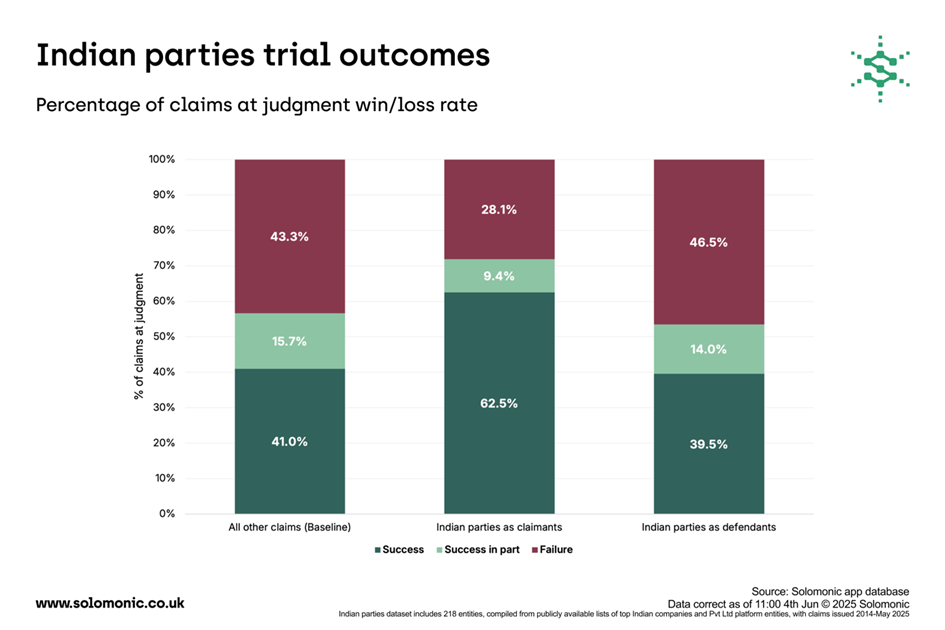
Backed by Solomonic’s data analytics team, the discussion revealed a number of growing trends among Indian parties, with the most significant finding being that Indian claimants had a significantly higher success rate (62.5%) compared to all other claimants (42.3%), highlighting the growing confidence in the UK judicial system among Indian litigants and the increasing strategic value of cross-border claims.
Unlocking access and opening gateways
English law offers multiple gateways for Indian claimants to bring cases before English courts, which are especially useful when the defendant is based overseas. Some of the most integral gateways for Indian claimants contemplating a claim are:
- when the defendant is domiciled in England;
- when one defendant is domiciled in England and is treated as an ‘anchor’ allowing other ‘necessary or proper parties’ to be joined to the claim against the anchor defendant;
- when the claim relates to a contract with an English jurisdiction clause, the contract is made in the jurisdiction or subject to English law, or the breach of contract takes place in England;
- in tort claims, when the harmful event occurs in England.
English courts are also decisive when it comes to deciding jurisdiction, which is crucial in cases involving allegations of fraud across borders. In Re Harrington and Charles Trading Co Ltd (in Liquidation) [2023] EWHC 307 [Ch], the court rejected a jurisdiction challenge in a billion-dollar fraud case involving two Indian companies and a consortium of Indian banks.
The defendants argued that India was the ‘centre of gravity’ of the dispute and was the more appropriate forum. However, the English court held firm, and ruled that although India was a possible venue, it was not ‘clearly more appropriate’ than England. The ruling relied on key factors such as proper service on the defendants, the claimant’s residence in England, and the location of substantial documentary evidence being in England.
Speedier solutions
Indian litigants are attracted to English courts due to its reputation for swift rulings and a proactive approach to summary judgment. The streamlined procedures and decisive posture of English judges offer a compelling route to resolution, which is crucial for litigants. Indian parties in contractual claims have a median claim length of one year and five months. For claims that end with summary judgment, the length is even lower at less than a year (357 days) – an attractive prospect from the English courts compared to Indian courts, which are well known to have a backlog.
Typical disputes
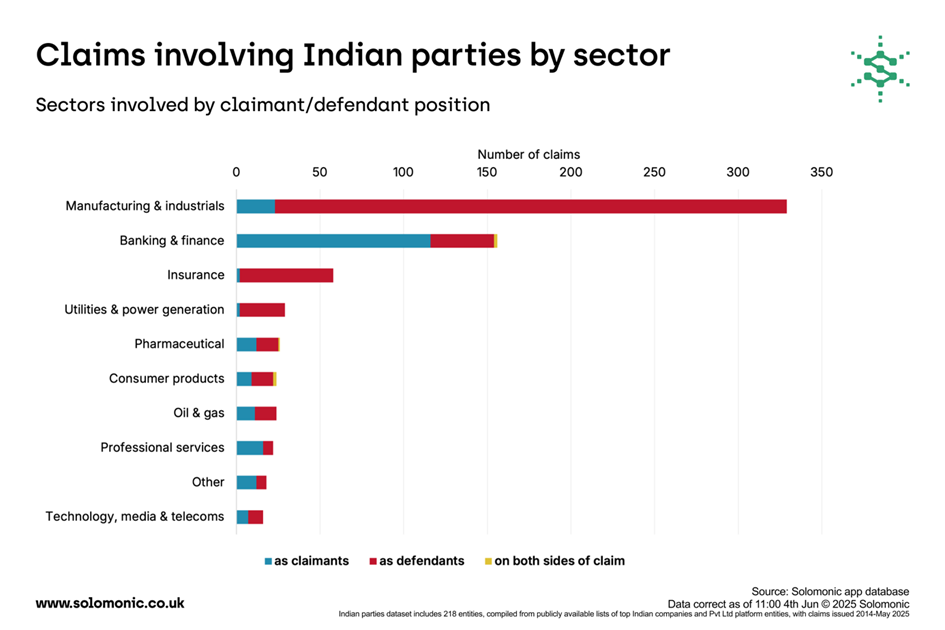
Indian parties most frequently appear in disputes within the manufacturing and industrials sector. These cases typically centre around breaches of contract, breaches of statutory duty, and negligence – reflecting the commercial complexities involved with cross-border industrial dealing.
In the banking and finance space, Indian parties heavily feature as claimants, often bringing high-value claims with a median value of £13.88 million. These disputes commonly involve non-payment under guarantees, with defendants frequently arguing that such guarantees are invalid due to alleged breaches of Indian law.
For example, in IDBI Bank Ltd v Axcel Sunshine Ltd & Anor [2025] EWHC 442 (Comm), IDBI Bank secured recovery of a $143 million loan from Axcel Sunshine, an Indian surety. Axcel Sunshine argued that a letter of comfort underlying the loan was provided only for optics, contravened an Indian legal requirement to obtain permission from the Reserve Bank of India, and was not meant to be relied upon. The court dismissed the claim and concluded that the letter of comfort had created a binding guarantee that was enforceable in India.
This judgment reflects a growing trend that English courts are increasingly trusted to resolve complex, high-value disputes involving Indian parties by delivering predictability, credibility, and global enforceability.
Ease of enforcement
The reciprocal enforcement regime operating under the Foreign Judgments (Reciprocal Enforcement) Act 1933 and The Reciprocal Enforcement of Judgments (India) Order 1958 allows judgments in both jurisdictions to be enforced in the other.
Earlier this year, the State Bank of India and other lenders successfully enforced an English bankruptcy order against prominent businessman and former Indian MP Vijay Mallya in connection to the collapse of the Kingfisher Airlines, securing recognition of a debt exceeding £1 billion. In State Bank of India & Ors v Mallya [2025] EWHC 858 (Ch), the Court of Appeal upheld the order, dismissing Mallya’s appeal and affirming the enforceability of the Indian court judgment.
A look to the future
The recently concluded India-UK free trade agreement promises to unlock new trade opportunities for both countries across goods, services and investment. However, with increased commercial activity comes the associated increase in legal friction. Indian parties, litigating across all different sectors will see increased prominence within English courts with the growing likelihood of contractual breaches and cross-border enforcement challenges. The enforcement of Indian judgments in England will also likely become a regular feature of the legal landscape as commercial ties deepen between the two countries. English courts will be expected to grapple with recognition and enforcement issues arising from Indian court rulings.
These emerging trends demonstrate that English courts are not only willing but have a strong track record of serving as an efficient and effective forum for Indian parties. Their openness to cross-border litigation, efficiency, and pragmatic approach to enforcement makes them a strategic choice for resolving complex disputes.
For more information and to obtain a copy of the Solomonic slides and a recording of the event, please contact Phillip D’Costa.
Related expertise
The Senior Managers Regime and the quest for growth

Last week there was a lot of activity in the world of financial services as Rachel Reeves set out her Leeds reforms, one of which was to reduce the regulatory burdens imposed by the Senior Managers and Certificate Regime (SM&CR).
The government was elected with a goal of growing the economy. For several economic and political reasons this goal is looking rather distant and indeed, the goodwill and confidence the government enjoyed a year ago is now questionable.
That said, these proposed reforms are not kneejerk reactions; they are subject to consultation and have taken much time in the planning. Their structure is set out in two phases, the first being the period prior to the government’s proposed abolition of certain legal requirements of SM&CR under the Financial Services and Market Act 2000 (FSMA). The Financial Conduct Authority (FCA) and Prudential Regulation Authority (PRA) have made modest proposals to streamline the existing system over this Phase 1 period. If the government goes ahead with abolishing the legal requirements, then Phase 2 will be the implementation of new rules from the regulators that are aimed at reducing burden and complexity.
The consultation that has already taken place identified that SM&CR in its existing form had succeeded in improving governance and accountability but that it could be streamlined. It recognised that high regulatory standards are good for the appeal and competitiveness of the City as a global financial services centre but that it has a heavier compliance burden than other financial centres. The FCA has the secondary objective of international competitiveness and growth. This objective has a strong influence on the proposals. The aim of the Treasury and regulators is to reduce the burdens of SM&CR by 50%.
The proposals to be consulted on:
The government
Senior Managers
- Reducing the number of Senior Managers, particularly for smaller firms.
- Allowing for certain Senior Manager functions not to require pre-approval by the regulators. Instead, individual firms will have to ensure that persons holding these functions meet fitness and proprietary standards (is this a new certification regime, albeit one much more limited in scope?).
Certification Regime
- Remove the regime from FSMA, specifically:
- the duty on a firm to ensure that a person is certified as fit and proper to carry out the role;
- the removal of annual certification.
The FCA
Phase 1 – streamlining
Senior Managers
- The 12 week period allowing cover for a Senior Manager without FCA approval will now apply to a firm making an application for SMF approval rather than having to have that person approved by the regulator within the 12 week period.
- Simplifying Form A and improving the guidance.
- Extending the validity period of criminal record checks from three months to six months.
- Allowing for periodic submissions, ‘at least every six months’ of updates to Statements of Responsibility rather than having to do so at the time of each change.
- Clarifying the role of an SMF7 – group entity Senior Manager, and the more general SMF18 – other overall responsibility.
- Raising the threshold for classifying as an Enhanced SM&CR firm.
The Certification Regime
The scope of it will not yet be reduced but:
- removal of duplication in certification; someone does not need to be certified twice for separate functions.
The Code of Conduct
- Clarification that where someone is suspended in order to carry out an investigation into a potential Conduct Rule breach, this is not reportable in itself as a Conduct Rule breach under SUP 15.11.
Regulatory references
- These are unlikely to be pared back immediately – but a previous employer will now have four weeks to respond to a reference request in order to speed up the new employer’s recruitment process.
Phase 2
The core to the reforms:
- reducing the number of Senior Manager roles;
- not all Senior Manager roles will need pre-approval by the regulator;
- the Senior Manager application process will be further streamlined;
- Statements of Responsibility and Prescribed Responsibilities will be simplified; and
- designing a streamlined regime to replace the current process of certification.
The PRA
The PRA consultation paper broadly reflects that of the FCA but does not agree with the four week window for regulatory references saying that a firm needs adequate time to prepare the reference. It also wants to clarify that current annual certification can use internal systems and formats.
Overview
Above all else it is the anticipated removal of the Certification Regime that is of note. The consultation suggested that the existing regime covers too many roles. The FCA supports the intention of the Treasury to replace the Certification Regime and aims to achieve a situation where fitness and propriety is ensured but without burdening firms.
It is hard to believe we will return to such a light touch of regulation that the infamous ‘bad apples’ can revert to the short-termism and poor behaviour that led to previous financial crises. We anticipate that the obligation will be on firms to ensure that they have effective management and policies in place even if there is not a certification process. There will still be adequate supervision. It will be interesting to see how the future regulatory references will look, and whether they will be quite so prescribed?
For now, let us hope the government and the regulators get it right and reach their goal of ‘proportionality’. The existing regime has been shown to work but the administrative burdens of it are well-known. We have all experienced the potential recruit from overseas being worried as to what will be required of them. But it would be a mistake if anyone believes that oversight and supervision will be done away with.
At the start of this month the government published its paper on tackling non-financial misconduct in financial services. If it was ever needed in the first place, there is now going to be unambiguous clarification that harassment, discrimination and bullying will be a breach of the Code of Conduct, if connected – albeit indirectly – to the workplace. In any event, such behaviour will call into question fitness and propriety.
So, let us see how long the next regulatory regime lasts, but for now any responses to these proposals should be with the government and/ or regulators by 7 October.
Related expertise
Related content
Finance Focus – Spring 2026

Evaggelos Th – implied warranty of safety in a time charter


As part of the bicentennial celebration of Thomas Cooper’s founding in 1825, Penningtons Manches Cooper is spotlighting a different standout case conducted by the firm across its two centuries of English legal practice for each month of 2025.
This seventh instalment focusses on the decision in Vardinoyannis v The Egyptian General Petroleum Corporation, The Evaggelos Th [1971] 2 Lloyd’s Rep 200; the only case in which a warranty of safety was ever implied into a charter party.
That same year, Thomas Cooper began trading as ‘Thomas Cooper and Stibbard’, having finally combined the names of Thomas Cooper & Co and Stibbard Gibson & Co, which the partners had been keeping alive since the merger of those practices in 1878. The new name would stick around for some 38 years.
The word ‘safe’
Recorded cases on port safety date back to 1861, affording the common law plenty of time to whittle its way towards certainty on the meaning of a safe port. Earlier references in The Sagoland (1932) 44 Ll.L Rep 136 and The Stork [1955] 1 Lloyd’s Rep 373 discernibly paved the way for Lord Justice Sellers to deliver one of history’s most oft-quoted pieces of maritime dicta in the seminal decision of The Eastern City [1958] 2 Lloyd’s Rep 127:
‘… a port will not be safe unless, in the relevant period of time, the particular ship can reach it, use it and return from it without, in the absence of some abnormal occurrence, being exposed to danger which cannot be avoided by good navigation and seamanship… .’
This conceptualisation would also stick around, meeting with the approval of the House of Lords in The Evia (No. 2) [1982] 2 Lloyd’s Rep 307 and the Supreme Court in The Ocean Victory [2017] 1 Lloyd’s Rep 521.
In order to so curtail a charterer’s discretion, entitling them to only choose safe ports for the vessel, the mere insertion into the charter party of the word ‘safe’ in relation to the subject port is normally enough. The law of safe ports presents itself as an edifice of common law jurisprudence, rendered contractually effective by this one-word express term.
Perhaps this is why the question of whether a warranty of safety ought to be implied where none is expressed is of some fascination to lawyers. In The Stork, at first instance, Mr Justice Devlin observed the importance of implying ‘some condition about safety to prevent the making of a derisory nomination’, and as early as Ogden v Graham (1861) 1 B&S 773, Mr Justice Wightman acknowledged that ‘I do not know what force can be given to the word ‘safe’ when added to the word ‘port’.’
Employed in a war zone
In the aftermath of the Six Day War of June 1967, an uneasy ceasefire persisted between Israel and Egypt with the port and Gulf of Suez within reach of both sides’ artillery. Vessels traded in and out of Suez, but sporadic shelling would cause the occasional casualty.
Against this backdrop, the Greek tanker Evaggelos Th was time chartered to the Egyptian General Petroleum Corporation by a charter dated 2 November 1968 for trading in the Red Sea. The charter stated that the vessel may be sent to any ‘place the charterers may direct, where the vessel can always lie safely afloat’ but did not contain any other stipulation for the safety of the places of loading and discharge. Initially, the vessel was traded between the refinery at Suez and the Egyptian oil fields in the Gulf of Suez.
On the evening of 8 March 1969, shelling began while the vessel was discharging in the Suez Roads. After charterers gave orders to halt the discharge, the master decided to vacate the jetty. However, being of the same mind, the shore staff had already abandoned their stations, leaving the ship’s crew to cut their mooring ropes with axes and make good their escape.
Over the following three days, two ships were sunk by shell fire at Suez, and another was damaged in Suez Bay, with a fourth vessel running aground while trying to get away.
Thereafter, with the refinery out of action, the Evaggelos Th was employed in carrying crude from the oil fields to Aden, refined products from Aden to Suez, and fresh water from Suez to the oil fields.
Having loaded a cargo at Aden on 13 June, the ship proceeded to the Suez Roads for discharge into lighters and arrived there on 21 June. Intermittent shelling began that afternoon, with shells landing in the water on the port side of the vessel by the following morning.
The Evaggelos Th shifted to get away from the immediate danger, but, on 25 June, with discharge still in progress, Israeli guns began firing at ships in the Suez Roads. The Evaggelos Th was hit at the break of the poop, causing drums of lubricating oil and kerosene on deck to ignite, and fracturing a steam pipe, which meant she could no longer raise anchor.
The master ordered the crew ashore in boats until the shelling ceased, following which he went back onboard with a skeleton crew to perform repairs. When shelling recommenced on 27 June, the master and crew again headed ashore. While they were en route, the Evaggelos Th was struck in the aft accommodation. Flames broke out and the vessel became a total loss.
High Court
Thomas Cooper acted for the charterers in the ensuing litigation.
Having failed to convince two LMAA arbitrators of their claim for damages arising out of charterers’ orders to discharge at Suez, owners appealed to the High Court. The arbitrators had been clear, as a matter of fact, that Suez and the Suez Roads were not safe on 25 and 26 June 1969, although that did not place the charterers in breach of charter.
Mr Justice Donaldson held that the wording ‘always lie safely afloat’ did not avail owners. This wording applies only to the marine characteristics of the place of discharging, ‘and requires that the vessel shall at all times be water-born and shall be able to remain there without risk of loss or damage from wind, weather or other craft, which are being properly navigated.’
There being no express safe port warranty, the judge considered the question of an implied one. He determined that a term should be implied ‘because common sense and business efficacy require it in cases in which the shipowner surrenders to the charterer the right to choose where his ship shall go’ and ‘the implied term should in my judgment be limited to a warranty that the nominated port of discharge is safe at the time of nomination and may be expected to remain safe from the moment of the vessel’s arrival until her departure.’
In the case of Evaggelos Th, however, the outbreak of hostilities on 8 March and 25 June 1969 were unexpected and the vessel had successfully traded to Suez in the intervening months. ‘[I]n the light of the fact that the vessel was being properly employed in a war zone’, and that there was no hostile action when the vessel was ordered to Suez on 19 June or when she arrived there on 21 June 1969, the implied term was not breached. The charterers had succeeded in defending the claim.
Legacy
The textbook Time Charters, 7th Ed, reminds us that the wording ‘always lie safely afloat’ does not mean the same thing as ‘safely lie always afloat’, which appears in the NYPE 46 and Baltime forms and ‘should be read as a stipulation for safety in all the aspects …’.
Conspicuous as the sole authority showcasing an implied warranty, the Evaggelos Th is not without its critics. In The Evia (No.2), Lord Roskill said that he agreed with the outcome but ‘would respectfully question its reasoning’, while Time Charters cites the case for the proposition ‘that the court may in certain circumstances imply a term as to safety’.
It may be inferred that Mr Justice Donaldson’s implied term could only be breached in circumstances where the danger of being ’employed in a war zone’ had markedly increased since the charter was agreed. If so, the decision would appear to accord with the prevailing view that a claim under an implied warranty of safety for damage caused by an order to an unsafe port would be coextensive with one brought under the employment and indemnity clause. The Evaggelos Th may not be as controversial as its singularity would suggest.
Related expertise
Related content
Colorectal surgeon Marc Lamah still operating in the NHS despite private hospital ban

A recent BBC investigation has revealed that a surgeon banned from working in private practice, due to concern about patient safety, has continued to operate on patients within the NHS, at the Royal Sussex County Hospital in Brighton. This raises serious questions about communication between the private and public healthcare sectors, and the standard to which doctors and surgeons are held within each sector.
The surgeon, Marc Lamah, was barred from working at Nuffield Health in Brighton following an independent investigation into his clinical performance. Nuffield withdrew his practising privileges in 2023 after it was found that one third of his patients had experienced a ‘moderate harm event’. The statistical average is 5%.
Despite this, Mr Lamah remains employed by the University Hospitals Sussex NHS Foundation Trust, which runs the Royal Sussex County Hospital, where he continues to treat NHS patients as a colorectal surgeon within the general surgery department.
The trust has stated that an audit of the surgeon’s NHS data showed his outcomes were within the expected national range, and that Nuffield’s investigation found ‘no concern with regard to technical abilities, surgical practice or patient safety’. However, according to the BBC investigation, former NHS colleagues of Mr Lamah have reportedly raised concern about him and the police are conducting an investigation into the trust, looking specifically at preventable deaths and injuries, after two whistleblowers raised concern of medical negligence in the trust’s neurosurgery and general surgery departments.
This divergence in findings between private and public healthcare providers arguably highlights a disparity between standards in the NHS and private sector, and the lack of a unified system for disciplinary findings between private and NHS institutions means that patients may unknowingly be treated by clinicians who have been sanctioned elsewhere.
Arran Macleod, a solicitor in the clinical negligence team at Penningtons Manches Cooper, said: “Patients should not be expected to conduct their own due diligence on the surgeons assigned to them. They should be able to trust that the surgeon is competent to perform their treatment safely. Many may reasonably ask why it is acceptable for Mr Lamah to continue operating in the NHS when a private hospital has determined that patients were unsafe in his care.
“It is deeply concerning that patients are still being placed under the care of a surgeon who has been found to have significantly higher complication rates than expected, potentially placing them at risk of avoidable harm. In some cases, the impact may be life-altering. This also raises questions about issues of informed consent, arising from a failure to disclose material information about the surgeon.”
The specialist medical negligence team at Penningtons Manches Cooper offers comprehensive legal support to patients who have suffered injuries arising from substandard medical care, and can provide initial advice if you have concern about treatment that you have received either privately or in the NHS.