Enhanced carbon reduction plan requirements for NHS suppliers: time to get ready

From April 2027, suppliers bidding for many NHS contracts will face expanded carbon reduction plan (CRP) requirements. A key change is that NHS procurement teams will expect more detailed, globally scoped emissions reporting, particularly for scope 3 emissions across the value chain. The requirements will apply to the procurement of goods, services and works, expressly including pharmaceuticals and healthcare services, by NHS bodies and other in-scope organisations.
The NHS net zero supplier roadmap
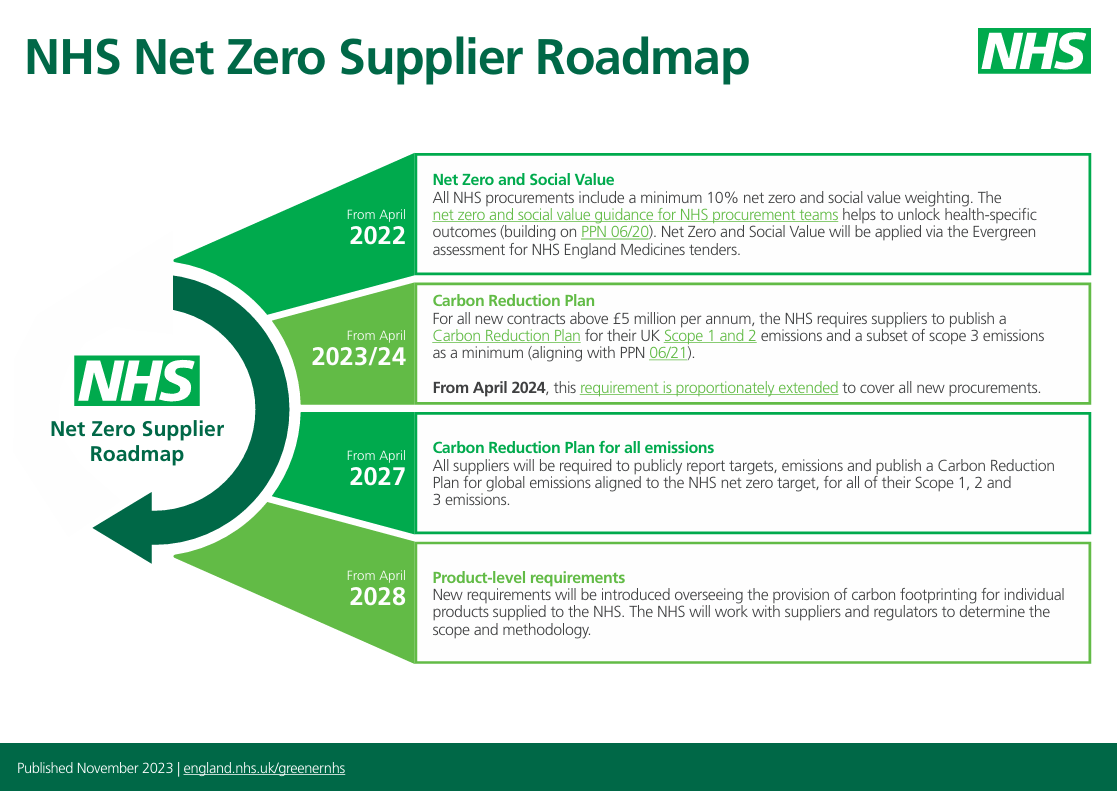
As part of its commitment to becoming a carbon net zero health system, NHS England recently updated its guidance on the ‘net zero supplier roadmap’, shown below.
What is changing from April 2027?
The NHS is moving to a tiered CRP regime. New, enhanced 2027 NHS CRP requirements will apply to contracts worth £5 million or more per annum (including VAT), and to all new frameworks, framework agreements and dynamic markets operated by in-scope organisations, regardless of contract value. Other, lower-value contracts above the relevant procurement threshold will remain subject to the 2024 CRP requirement that only necessitates reporting of a limited subset of scope 3 emissions.
The practical significance for pharmaceutical suppliers is that a CRP will no longer be a light-touch procurement document for major tenders only. Businesses supplying medicines, devices, clinical services or associated logistics into the NHS may need to revisit group reporting structures, emissions data capture, and bid governance well before April 2027.
What are the new requirements for the enhanced 2027 NHS CRP?
In addition to the baseline 2024 CRP requirements, it will become mandatory to include the following in the 2027 NHS CRP:
- a global geographical boundary for emissions reporting. It will no longer be acceptable to limit emissions reporting to UK sites only; and
- scope 1, scope 2 and all relevant scope 3 emissions, per the GHG Protocol Corporate Value Chain Standard. This is a significant increase in reporting requirements compared with the 2024 NHS CRP, which only involves reporting of scope 3 emissions in five relevant categories (upstream transportation and distribution, waste generated in operations, business travel, employee commuting and downstream transportation and distribution). Under the extended requirements, suppliers will be required to assess all 15 scope 3 categories, report the ones relevant to their business, and provide justification for any category not reported.
It is important to note that these additional requirements are the baseline for the 2027 NHS CRP. The NHS has published further ‘best practice’ guidance for suppliers that are more onerous, including recommendations that the supplier confirms its commitment to achieving net zero even earlier than 2050, and that any net zero targets are independently validated by a third party. For supplier organisations owned by an overseas parent entity, it is recommended that both the parent company and local supplier confirm their commitment to achieving net zero.
The NHS recommendations are set out in annex 2 here. While they are not mandatory, it is likely that the NHS will scrutinise updated 2027 NHS CRPs for evidence that the recommendations have been considered.
Exceptions
There will be some flexibility in the system, in that the owner of a framework or dynamic market can decide in certain circumstances that the less demanding 2024 NHS CRP requirements will apply. In a limited set of exceptional circumstances, the NHS may not require any CRP at all.
Key practical steps for pharmaceutical suppliers
- Identify whether NHS supply contracts are likely to be subject to the 2024 or 2027 requirements. The 2027 NHS CRP will be the default option for those supplying via NHS frameworks or dynamic markets, and for high value contracts.
- Decide the right reporting entity. Groups should decide whether the CRP will be produced by the UK NHS-supplying entity or by a parent entity. If the CRP is provided by the parent entity, it must expressly cover and be adopted by the NHS supplier.
- Expand scope 3 emissions workstreams. For pharmaceutical companies, scope 3 can be complex and so sufficient time should be given to gather and analyse the relevant data. It may include purchased goods and services, active pharmaceutical ingredient sourcing, outsourced manufacturing, freight and distribution, business travel, waste, product use and end-of-life treatment. Where hard data is not available, estimates will be acceptable. Subcontractor emissions may form part of the prime supplier’s scope 3 footprint. NHS suppliers should therefore review contract terms with logistics providers, contract manufacturers, wholesalers, packaging suppliers and other key partners to ensure they can obtain any necessary emissions data.
- Apply a global boundary. For a UK subsidiary, this does not necessarily mean reporting every emission of the global corporate group. However, it does mean that the supplier’s organisational boundary should include relevant global emissions connected with that supplier, for example, overseas purchasing or freight linked to UK NHS supply.
- Gain board or company director approval of the CRP. Suppliers should allow sufficient time in their project timeline for approval of the CRP by the board, or by a company director where there is no board.
- Build annual review into governance. Suppliers should review and update their CRP annually, and within six months of the organisation’s financial year-end. This should be built into the company’s bid-readiness, ESG reporting, and legal sign-off timetable.
- Publish an updated CRP in good time before April 2027 procurement activity begins. Pharmaceutical suppliers should treat the 2027 CRP requirements as a procurement-readiness issue, not just an ESG reporting issue. The CRP must be clearly signposted and published on the supplier’s website.
Early preparation should put suppliers in a strong position when tender questions begin to focus on global emissions, scope 3 methodology, and governance of net zero commitments.